
Reviewed · WALKING TOURS
Discover Valletta Half-Day Walking Tour
Valletta is the kind of place where 3 hours can feel like a full day, if you hit the right corners. This half-day walking tour is designed to get you fast orientation, then give you freedom to choose what you want to pay to enter. You start near Floriana and end at the Grand Harbour area, with time to keep exploring after the tour finishes.
I like that you get major landmarks covered in one efficient route, from the City Gate area to the Grandmaster’s Palace zone and out toward Fort St Elmo. I also like the built-in structure around the views, especially the Upper Barrakka Gardens pause and the option to top off with the Malta Experience show. One consideration: most entrances and museums are not included, so your final spend depends on how many optional sites you choose.
Key things I’d watch for on this Valletta walk
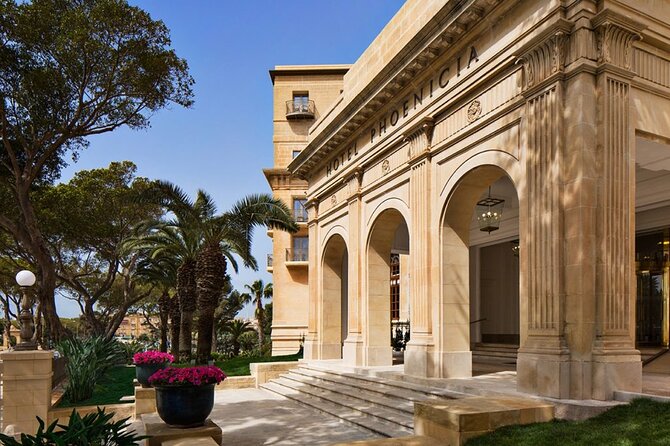
- A simple start, near The Phoenicia Malta, so you can actually find the group without stress
- Renzo Piano connections everywhere, from the modern Parliament to the Opera House ruins
- Free time that matters, including 45 minutes at St John’s Co-Cathedral and Museum (tickets extra)
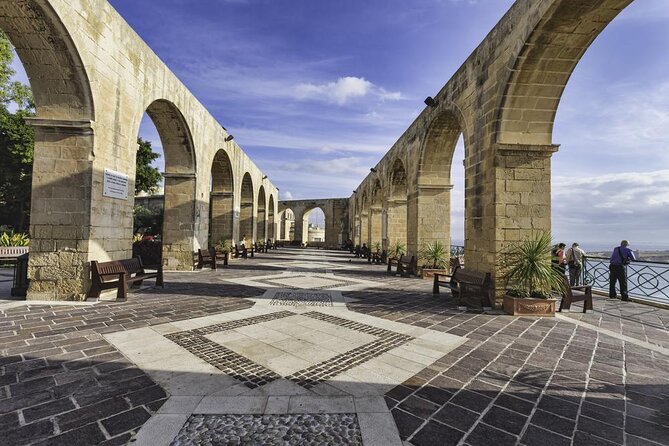
- Harbour views built into the route, with time at Upper Barrakka Gardens
- End at Fort St Elmo and Malta Experience, a smooth way to understand the big picture before you wander on your own
Entering Valletta with a half-day route that still leaves you room
If you only have part of a day in Valletta, this tour makes a lot of sense. The route focuses on the city’s core and climbs to viewpoints, but it doesn’t drag you through every side street. Instead, it gives you the spine of the capital, plus the high points where the sea and harbors open up.
At a cost of $22.11 per person, the value is mostly about logistics and guide time. You’re paying for a professional licensed guide, a group structure (so it stays affordable), and a route that strings together big-name places without you having to figure out what’s where. The tour is also short enough that it won’t steal your whole afternoon.
The main thing to understand is that the tour is not an all-inclusive museum pass. Several stops are free to look at from the outside, while the deeper interiors you may want to visit come with separate ticket prices.
Other walks around Malta:
- Valletta: Guided Walking Tour with Optional Cathedral Tour
★ 4.3 · 758 reviews - The Valletta Street Food and Culture Walking Tour
★ 5.0 · 711 reviews - Valletta Private Walking Tour
★ 5.0 · 163 reviews
Meeting point at The Phoenicia Malta, then a walk built for good pacing
The walk starts at 9:15 am at The Phoenicia Malta in Floriana (near The Mall). The meeting point is set up to be easy to locate, and the tour includes a mobile ticket, which is handy if you prefer to keep everything on your phone.
Group size is capped at 50 travelers, so you’re usually not stuck in an oversized crowd. Still, it is a group walk, so you should expect a bit of waiting when everyone regroups. One note from real-world experiences: timing can vary, and there have been instances where the group waited close to an hour for everyone to arrive. It’s not guaranteed, but it’s smart to arrive a few minutes early so you’re not rushed.
There is no hotel pickup or drop-off transport. You’re doing the walking and getting there on your own, but the start point is described as being near public transportation.
Triton Fountain and Valletta City Gate, getting your bearings fast
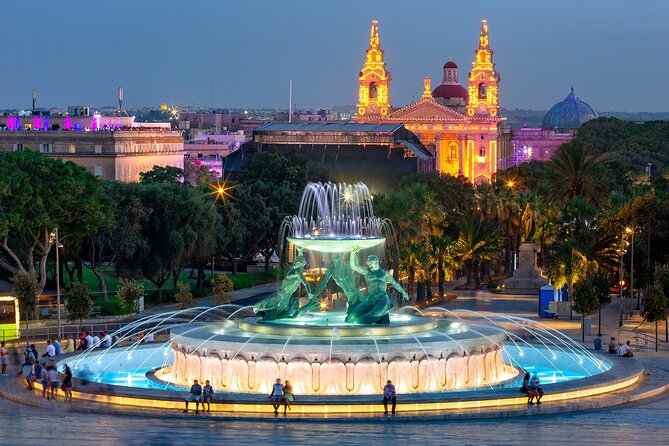
The tour begins outside Valletta at the Triton Fountain, just beyond the City Gate. This fountain is one of Malta’s standout modernist landmarks, inaugurated in 1959 and restored in 2018. I like this opener because it quietly sets up a key Valletta idea: the city mixes centuries of fortifications and religious architecture with newer layers of design.
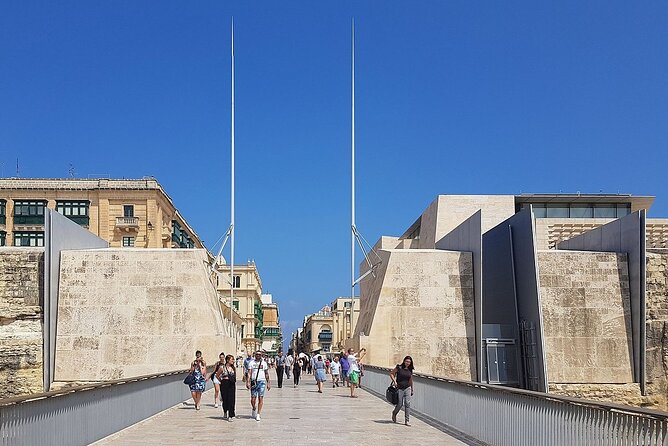
From there, you head to Valletta City Gate. The gate sits within the Porta Reale Curtain, a curtain wall that connects St. James’ and St. John’s Bastions. Even if you are not a “fortifications person,” you’ll appreciate the scale. The gate marks the start of Republic Street, Valletta’s main drag that runs across the city toward Fort St Elmo.
A detail worth clocking: the current gate completed in 2014 was designed by Renzo Piano, so you’re already seeing how Valletta keeps updating while staying itself.
Both Triton Fountain viewing and the City Gate stop have free admission, so this is a low-cost way to start strong.
Renzo Piano landmarks: Parliament, Opera House site, and what they say about Malta
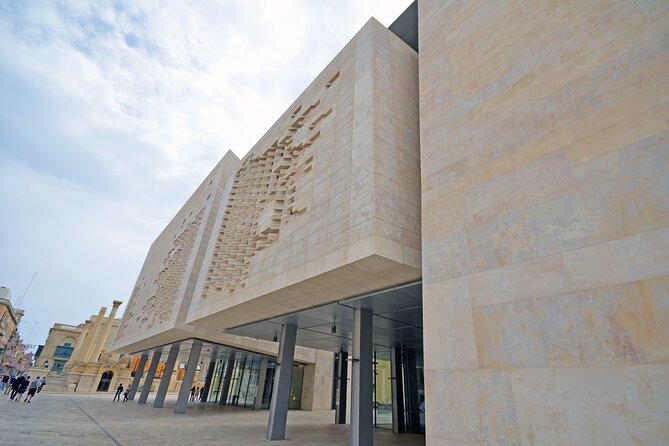
Two stops in the middle of the walk show you Valletta’s modern identity without losing the historic thread.
First is the New Parliament, built between 2011 and 2015, also credited to Renzo Piano. The building uses a steel frame clad in Gozitan limestone. There’s a thoughtful symbolism here too: the structure is intended to represent honeycombs, tying back to the name Malta. The name is tied to Melite, said to mean honey, which gives you something memorable to connect the architecture with.
Next you pause at the Royal Opera House site. This is a powerful stop because it tells a story of destruction and rebuilding. The original opera house was finished in 1866, but it took a direct hit from aerial bombing in 1942 during World War II. Later, the ruins were redesigned by Renzo Piano, and in 2013 it returned as a performance venue. Even if you don’t go inside, the site helps you read Valletta as a city that absorbs shock and carries on.
These are short stops, about 5 minutes each. If you want more than a quick narrative, you may need to linger on your own during free time later, but the guide’s context is usually what makes these pauses click.
A few more Malta options to weigh up
- Half-Day Tour of Mosta, Ta’Qali Crafts Village & Mdina
★ 4.1 · 110 reviews - Blue Grotto and Marsaxlokk Half-Day Tour from Valletta
★ 3.5 · 53 reviews - Malta: Private Half-Day Archeological Sites Tour
★ 4.9 · 15 reviews - Malta: Half-Day Quad Bike Adventure Tour Including Transfers
★ 4.5 · 11 reviews
Auberges and high viewpoints: Castille Palace, MUŻA, and Upper Barrakka Gardens
Valletta’s Auberges are where the city becomes really legible. These buildings were tied to the Order of Saint John, and the architecture helped reinforce power. Walking past them, you get a sense of how much of Valletta’s identity was shaped by knights, administration, and defense.
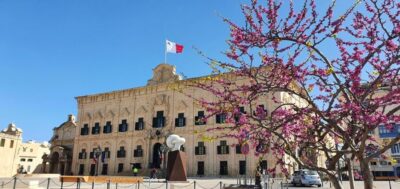
At the highest point of the city you reach Auberge de Castille (Castile Palace). It was built in the Baroque style in the 1740s under Manuel Pinto da Fonseca, replacing an earlier 1574 building used for knights from the langues of Castile, León, and Portugal. Today it houses the Office of the Prime Minister of Malta. This kind of modern use is one of the reasons Valletta feels alive instead of frozen in time.
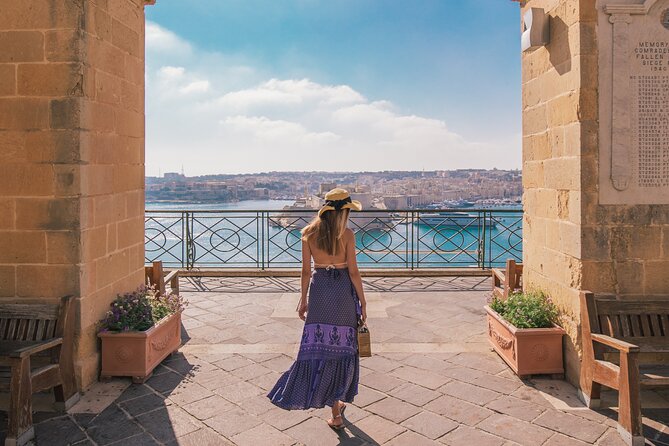
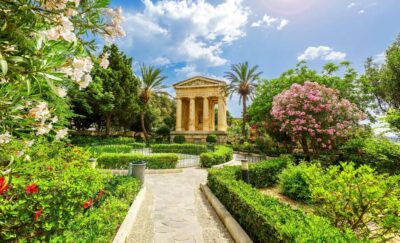
Then you get to Upper Barrakka Gardens, one of the best “free” bonuses of the entire walk. You’ll have around 15 minutes here to take in the view of the Grand Harbour, the Three Cities, and also the shipyard and lower parts of Valletta. The gardens sit on the upper tier of St. Peter and Paul Bastion, built in the 1560s, and they were originally for knights’ recreation. It’s a small stop, but it’s one of those places where the city’s history turns into a postcard view in real life.
After that, you pass Auberge d’Italie, late 16th century, now home to the National Art Museum (MUŻA) since 2018. If you’re the type who likes museums, this is a great “see it from outside first, then decide” point.
Palazzo Parisio and the Grandmaster core: big names, layered uses
As you move toward the center, you hit buildings where Malta’s story is tied to different eras of rule.
Palazzo Parisio was built in the 1740s by Domenico Sceberras, later associated with the Muscati and Parisio Muscati families. It was Napoleon’s residence for six days in June 1798 during the French occupation. Later uses were also significant: it became the General Post Office from 1886 to 1973, then served the Ministry for Agriculture, and now houses the Ministry for Foreign Affairs. This is a stop that helps you understand why Valletta’s architecture keeps getting reused instead of abandoned.
Next comes St. George Square, also called Palace Square. It’s Valletta’s largest and most prominent square, right in the heart of the city in front of the Grandmasters’ Palace. The square has changed appearance over time, but it remains a stage for important events, which adds a sense of ceremony to what might otherwise feel like another plaza.
Then you reach the Grandmaster’s Palace itself. Built between the 16th and 18th centuries as the palace of the Grand Master of the Order of Saint John, it later served as the seat of the Parliament of Malta from 1921 to 2015. Today the palace houses the Office of the President of Malta and also includes Palace State Rooms and the Palace Armoury, which are open as a museum.
This is the part of the walk where you can decide how deep you want to go. The tour stop is short, but the building is so central that even “just seeing it” gives you a strong anchor point for the rest of your day.
St John’s Co-Cathedral free time: how to make the 45 minutes work
One of the most valuable parts of the itinerary is the 45-minute free time at St. John’s Co-Cathedral and Museum on Republic Street. Entrance is not included, but this is your real chance to go beyond exteriors.
Here’s what you can do in that window:
- You can purchase tickets to visit the Co-Cathedral and Museum, including the Caravaggio masterpieces in the Oratory, Flemish tapestries, and the church museum.
- The Co-Cathedral has famous marble inlaid floors, and the entrance includes a multilingual audio guide.
- If you’re not going in, Republic Street gives you shopping and coffee options, and you can also relax around Republic Square or nearby piazzas.
This free time is timed so you can come back to the group at the agreed place after 45 minutes. My practical take: if you’re going to buy tickets, you’ll want to commit immediately after splitting off. Co-Cathedral entry can take time, and you don’t want to lose half your window just getting oriented.
This stop is often where guides shine. In particular, top-rated experiences include guides like Josephine who connect the Co-Cathedral stop to Malta’s wider story, so you’re not just looking at art, you’re understanding why it matters in Valletta.
Fort St Elmo and the Malta Experience show at 13:00
As the tour moves toward the waterfront, it centers on a key defensive location: Fort St Elmo. It’s a star fort on the seaward shore of the Sciberras Peninsula, sitting between Marsamxett Harbour and Grand Harbour, and controlling access to both harbors along with Fort Tigné and Fort Ricasoli.
Fort St Elmo is best known for its role in the Great Siege of Malta of 1565. Since 1975, part of the fort has housed the National War Museum. If you like military history or you want context for the city’s fortifications, this is a meaningful ending point.
The tour itself ends at 12:45 pm at the Malta Experience entrance at St Elmo Bastions, Triq Il-Mediterran, Il-Belt Valletta. You can buy tickets for the 45-minute Malta Experience multilingual audio-visual show at 13:00. It’s a practical way to tie together what you just walked through, especially if your time is limited later.
There’s also an option to get a drink and something to eat overlooking the Grand Harbour, though meals are not included. This is a smart finish because it turns your walking effort into a calm, seated payoff.
A real-world detail that matters: guides who close well tend to make the handoff to the Malta Experience smoother. One especially positive end-of-tour pattern involves guides who make sure you leave with the story fully connected, not just “see you later.”
Price and value: what $22.11 buys you, and what it does not
At $22.11 per person, you’re paying for:
- A professional licensed guide
- A half-day group walking tour (approx. 3 hours 15 minutes)
- A route that covers a lot of ground efficiently
- A structured set of pauses at landmarks and viewpoints
You are not paying for:
- Entrance tickets inside museums and cathedrals, where noted as not included
- Any food or drinks (unless you choose them at the Malta Experience area)
- Hotel pickup and drop-off
So the value comes down to you. If you enter St John’s Co-Cathedral and add the Malta Experience show, you’ll likely feel you got full use of the ticket. If you stick mostly to exterior viewing plus the free time, you can still enjoy the city, but your total day spend will be lower because you chose fewer paid interiors.
Also keep in mind that the tour can be multilingual. The guide might speak one language normally, but sometimes it runs as two languages. Depth of explanation can vary depending on how the group tour is handled, and at least one experience included criticism for limited explanations in a bilingual format. If history depth is your top priority, it’s worth checking what language you booked and aiming for a single-language guide when possible.
Who this tour suits best, and who should think twice
This is a strong fit if you:
- Have limited time and want a high-efficiency walk
- Want your bearings in Valletta without spending the entire day planning
- Like viewpoint stops and big “at-a-glance” landmarks
- Are comfortable paying extra for a couple of key entrances
You might think twice if you:
- Want every stop to include an entry ticket, guided inside every museum (this one is not built that way)
- Prefer a lot of time staying in one place, instead of moving between several sights
- Know you need very deep, uninterrupted narration, because group walking tours sometimes shorten explanations at busy points
Should you book this Valletta half-day walking tour?
Yes, if you want Valletta in a manageable chunk. The route gives you a great mix: City Gate orientation, important symbolic buildings tied to modern architecture and wartime rebuilding, and a viewpoint break at Upper Barrakka Gardens. The biggest reason to book is that you end with a logical cultural wrap-up at Fort St Elmo and the Malta Experience show.
Before you go, plan your budget around one or two paid interiors. St John’s Co-Cathedral is the obvious choice, and the Malta Experience gives you a good payoff if you’d rather sit and absorb than keep walking.
If you are sensitive to timing, arrive early at the start point. And if you care most about storytelling, choose your language carefully when booking.
Overall, it is a practical way to see Valletta without turning your day into a logistics puzzle.
FAQ
What time does the tour start?
The tour starts at 9:15 am.
Where is the meeting point in Valletta’s area?
The meeting point is The Phoenicia Malta, The Mall, Floriana, Malta.
How long is the walking tour?
The tour lasts about 3 hours 15 minutes, with an end time around 12:45 pm.
Where does the tour end?
It ends at the Malta Experience entrance at St Elmo Bastions, Triq Il-Mediterran, Il-Belt Valletta VLT 1253, Malta.
Is admission to all sights included?
No. Some stops are free to view from the outside, but several entrances are not included. St John’s Co-Cathedral and Museum require paid tickets, and the Malta Experience show is also paid.
Are there free stops during the tour?
Yes. Stops like Triton Fountain, Valletta City Gate, Upper Barrakka Gardens, St George Square, and the Grandmaster’s Palace exterior viewing are listed with free admission.
Do I need to buy tickets for the Malta Experience?
You can purchase tickets for the 45-minute Malta Experience show, entrance is not included.
Is transport included from hotels, and is cancellation flexible?
Hotel pickup and drop-off are not included. Free cancellation is available if you cancel at least 24 hours before the experience start time. Service animals are allowed and the tour is near public transportation.
Added recently in Malta
- Reggae Sunset Cruise in Malta★ 4.5 · 3 reviews
- Valletta City of Gentlemen guided walking tour★ 3.5 · 3 reviews
- Sensory Coffee Master Class: A Unique Island Experience★ 5.0 · 4 reviews
- Truffle Making Master Class★ 4.5 · 5 reviews
- Valletta’s Hidden Minds: Self-Guided Psychological Puzzle Walk★ 4.0 · 6 reviews
- Victoria Lines Tour★ 5.0 · 8 reviews
- Valletta: Private Massage from a world renowned masseuse★ 4.6 · 9 reviews
- Private Walking Tour of Vittoriosa /3 Cities★ 5.0 · 9 reviews
Walking Tours, compared.

Valletta: Street Food and Culture Walking Tour
Read our review →
Valletta: Guided Walking Tour with Optional Cathedral Tour
Read our review →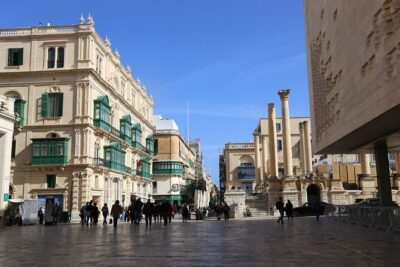
The Valletta Street Food and Culture Walking Tour
Read our review →Browse the lists this tour appears in